What a Power Strip Should and Should Not Be Used For
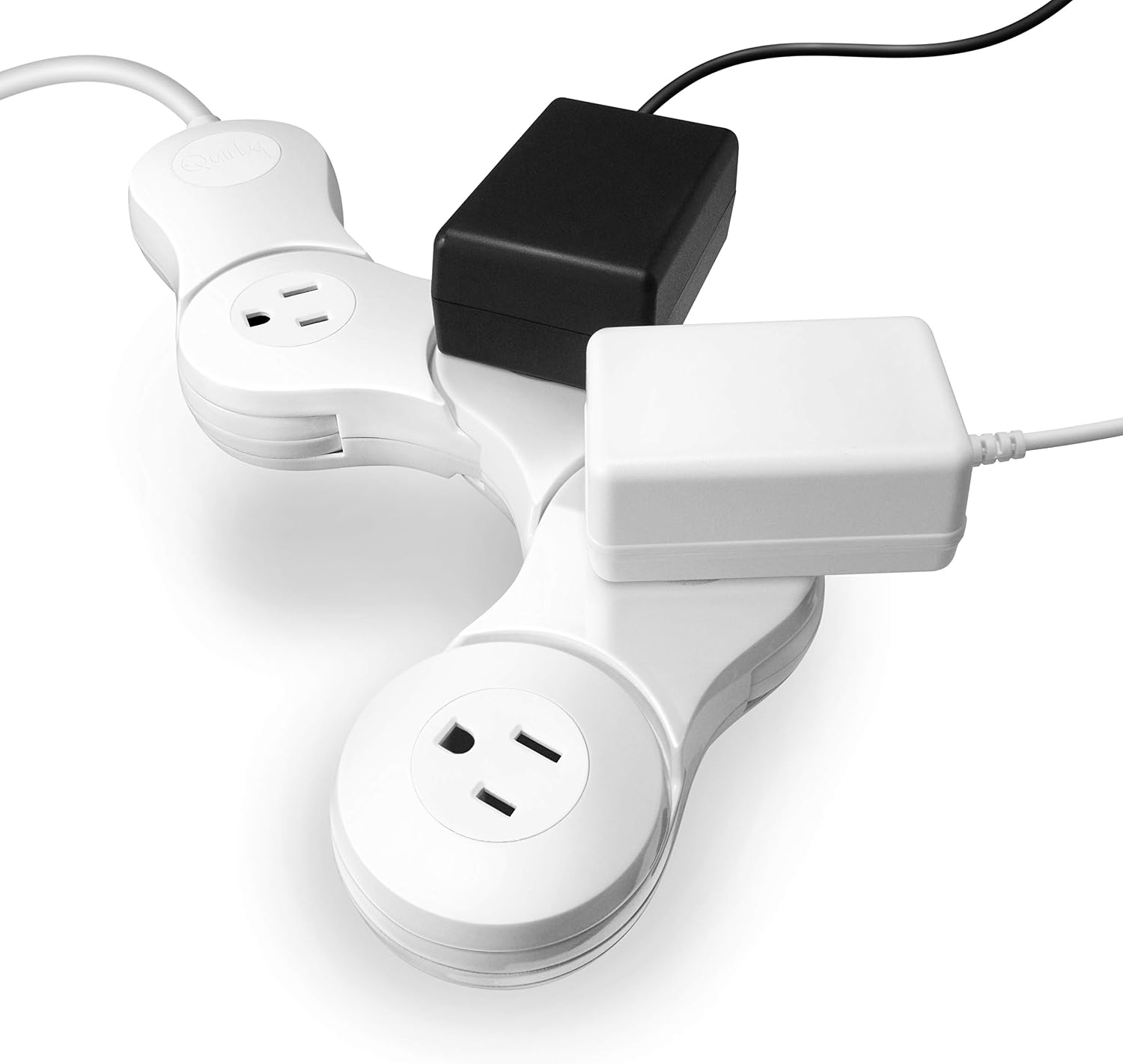
A power strip is the cheapest and most commonly misused item in any apartment. The rules that matter are short, they are about current rather than about the number of sockets, and most people have never been told them.
A strip does not create capacity
Plugging a six-outlet strip into a wall socket does not give you six sockets' worth of power. It gives you one socket's worth, divided among six plugs. The circuit behind the wall is unchanged.
This is why a strip feels fine with six low-draw electronics and trips or overheats with two appliances. It is the total current, not the plug count, that matters.
Most household circuits are rated at 15 or 20 amps, shared across several outlets in the room.
Never daisy-chain
Plugging one strip into another multiplies the number of connections without adding capacity, and it moves the total load further from the protective device. It is prohibited by most electrical codes and by nearly every workplace policy for good reason.
It also defeats surge protection: a protector expects a direct path to earth, and chaining introduces resistance and additional failure points.
If you need more outlets in a place, the correct answer is either a strip with more outlets or another wall socket, not two strips in series.
Heating appliances belong in the wall
Space heaters, kettles, toasters, irons, hair dryers and air fryers draw high sustained current and should be plugged directly into a wall outlet. A strip's internal wiring and switch contacts are not designed for that duty cycle.
This is the single most common cause of melted power strips. The strip does not fail dramatically; it warms, the contacts degrade, resistance rises, and it warms further.
Any appliance with a heating element or a compressor is in this category.
Reading the strip's own rating
Every strip carries a maximum rating, commonly 15A / 1875W in North America. That is the total across all outlets. Add up the wattage of what you intend to plug in and stay comfortably below it.
A desk of computer, two monitors, a lamp and phone chargers is typically under 400W and is entirely fine. A desk plus a space heater is not.
The rating is on the underside of the strip, and it is worth reading once.
Switches, and using them
An individually switched strip lets you cut power to devices that draw standby current. Over a year that is a small but real saving, and more usefully it means an unused device is genuinely off rather than idling.
A master switch is convenient for a desk you want to shut down entirely, though be careful not to include anything that dislikes abrupt power loss, such as an external drive.
Switched strips also make it obvious at a glance what is live.
Placement and heat
Do not run a strip under a rug or a carpet. Foot traffic damages the cable insulation and the covering traps heat, which is exactly the combination that starts fires.
Keep strips off soft furnishings and out of enclosed cabinets with no airflow. A strip behind a media unit needs a gap around it.
Mount strips where you can see the indicator lights, so a failed surge protector does not go unnoticed for a year.
Cable management that does not create a hazard
Do not coil excess cable tightly into a loop while it is under load; a coiled conductor carrying current builds heat. Fold it in a loose figure of eight instead if you must gather it.
Use cable clips along a skirting board rather than staples through the cable, which is a genuine cause of insulation damage.
Label the plugs. It sounds fussy and it prevents unplugging the wrong thing under a desk.
When to throw one away
Discard any strip with a warm or discoloured outlet, a plug that is loose in the wall, a damaged cable, or a protection indicator that has gone out. None of these are repairable and all of them are cheap to replace.
Also discard anything without a recognisable safety certification mark. There is a large market in uncertified strips and their internal wiring is frequently underspecified.
The strips we stock carry their ratings and certification on the listing.
Where to go next
Switched surge-protected power strips are in Power Strips, with ratings on each listing.
Shop Power Strips
Related articles
- Active Noise Cancelling Explained Before You Fly — What ANC removes, what it cannot, and why a cabin is the ideal environment for it. How to choose a pair for long flights.
- Your Laptop Has No Headphone Jack — What You Need — Passive versus DAC adapters, USB-C to 3.5mm, and why a cheap dongle sometimes produces silence. How to buy the right one.
- Replacing a Headphone Cable Instead of the Headphones — Most dead headphones have a broken cable, not a broken driver. How to diagnose it and what a repair needs.
- Choosing a USB Flash Drive That Is Actually Fast — Read speed, write speed, USB generation and why a large cheap drive can be slower than a small one. What to check.
- Earpads, Cables and the Parts That Wear Out First — Headphones rarely fail all at once. The pads, the cable and the headband go in a predictable order, and each is cheap to address.